
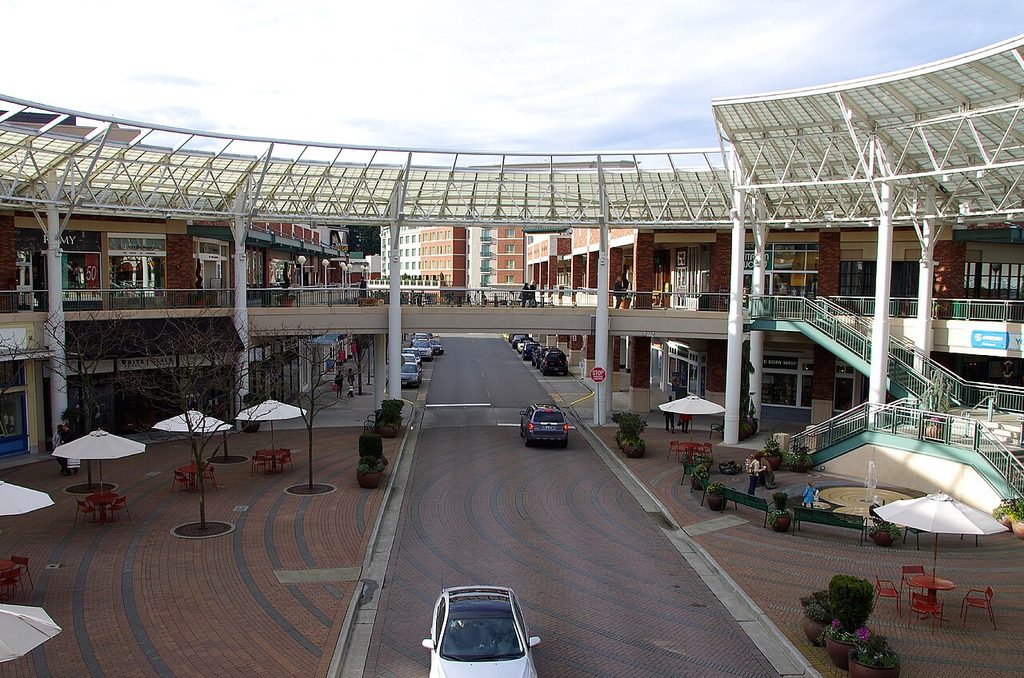
Redmond Town Center sits along the north side of State Route 520 in downtown Redmond, Washington, functioning as one of the Eastside’s most significant retail, dining, and office destinations. For residents who drive through or around the district regularly, the center is more than a shopping destination. It sits at the intersection of heavy commuter traffic, dense parking infrastructure, and the Pacific Northwest’s distinctive wet-weather driving season, three factors that shape how vehicles perform and wear over time in this specific corner of King County.
A 120-Acre Retail and Office Campus
Redmond Town Center opened in 1997 on a 120-acre property that had previously served as a golf course, developed by Winmar, a real estate arm of Safeco Insurance. The complex grew into an open-air mixed-use destination encompassing roughly 674,287 square feet of retail space, multiple office buildings, and two Marriott hotels. Fairbourne Properties acquired the retail portion in late 2019 and has continued to operate the shopping and entertainment core.
Today the property houses more than 110 shops, restaurants, and entertainment venues alongside a growing roster of corporate office tenants. Amazon occupies office space in a building that once held a department store, while Volkswagen leases space formerly used by an outdoor retailer.
Microsoft and AT&T also maintain offices on the property, and a large Asian supermarket, an entertainment-focused movie theater, and a national pet supply retailer round out the retail mix. This blend of shopping, dining, lodging, and daytime office work generates a traffic pattern that differs sharply from a typical suburban strip mall, since visitors arrive throughout the day rather than concentrated around evening or weekend peaks.
Traffic Volume Along State Route 520
Vehicle owners who navigate the area encounter one of the busier stretches of roadway on the Eastside. According to state traffic count data, the Washington State Department of Transportation recorded roughly 80,000 vehicles per day near the SR 202 interchange in Redmond, close to the retail center’s eastern edge. Unlike many commuter corridors, SR 520 near Redmond carries a comparatively balanced flow in both directions during peak periods rather than a single dominant rush-hour surge, a pattern transportation planners describe as a lack of reverse commute.
That traffic pattern lines up with how the property itself operates. Because Redmond Town Center pairs all-day office tenants like Amazon, Microsoft, and AT&T with retail, dining, and entertainment uses, the district draws visitors throughout the day rather than in a single concentrated wave, and the balanced two-way flow on SR 520 mirrors that steadier rhythm.
Multiple signalized access points connect the property to SR 520 and the surrounding street grid, giving shoppers and diners several ways to reach the center’s various parking areas rather than relying on one main entrance.
Wet-Weather Conditions Shape the Seasonal Visitor Experience
Redmond experiences a warm-summer Mediterranean climate, characterized by dry summers and cool, wet winters, with November typically standing as the wettest month of the year according to regional weather records. While snow accumulation remains uncommon compared to areas farther from Puget Sound, the region still sees periodic freezing temperatures. Redmond’s official record low of minus 7 degrees Fahrenheit, set in January 1950, shows that cold snaps and the ice they can leave on shaded parking areas and overpasses are far from impossible.
For anyone visiting Redmond Town Center, that wet-season pattern shapes the day-to-day experience of the property more than it does the driving itself. Because the center is built as an open-air destination rather than a single enclosed mall, moving between the shops, restaurants, and the movie theater usually means stepping back outside, so visitors tend to plan around the rain rather than avoid it altogether.
Umbrellas and quick dashes between storefronts are simply part of a visit here for much of the fall and winter, and the property’s multi-level parking structures offer shoppers at least one way to stay under cover for part of the walk.
Parking Infrastructure and How Visitors Move Through the Property
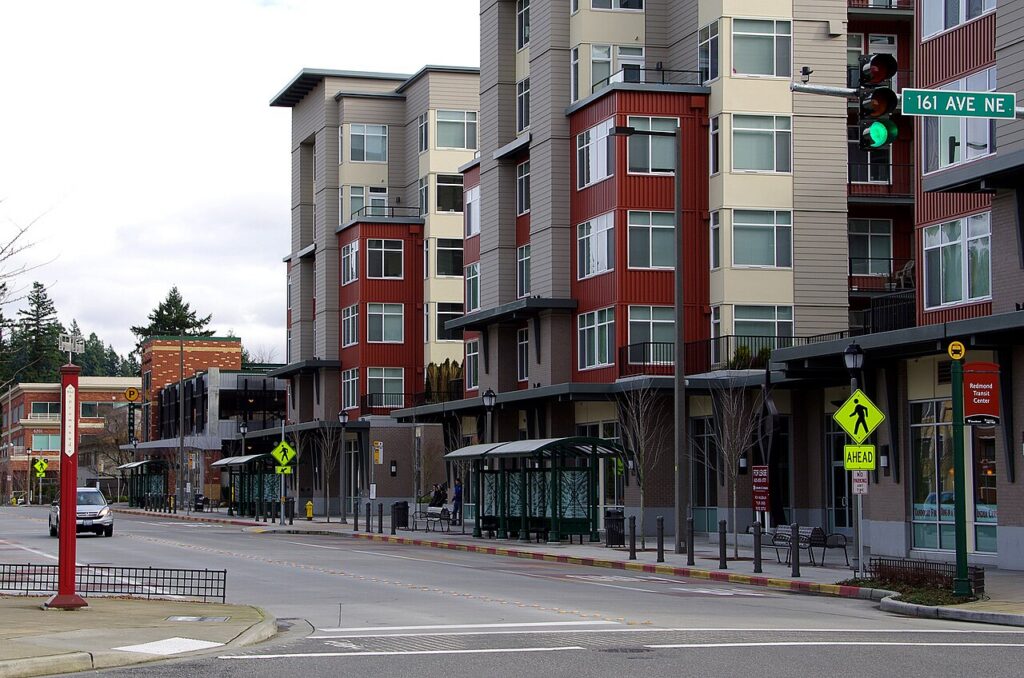
The retail center’s layout, built around surface lots and multi-level parking structures rather than a single enclosed mall, shapes how visitors actually move through a typical trip.
Rather than parking once and staying under one roof, shoppers commonly park near one cluster of stores, walk that section, then drive or walk to another part of the property to reach a restaurant, the movie theater, or an office appointment. That layout spreads foot traffic and parking demand across the property’s several lots and structures instead of concentrating it in one central location.
That stop-start rhythm across a single visit is simply part of how a sprawling, multi-building retail campus like this works, especially compared to a single enclosed mall where a shopper parks once and stays put. For drivers curious how that kind of frequent short-distance driving affects a vehicle over time, Otto European Repair’s general vehicle maintenance resources cover the topic in more depth.
A Shifting Mobility Landscape
Redmond’s transportation picture has continued to evolve. Light rail service connecting Redmond to Seattle became operational during 2024 and 2025, offering an alternative to driving for some trips that previously relied entirely on SR 520 and local surface streets. Property plans announced in 2022 also call for additional mixed-use development on portions of the center’s parking lots, aimed at improving walkability across the site.
These changes suggest that while personal vehicles will remain central to how most residents reach the retail hub, the balance between driving, parking, and transit around Redmond Town Center is gradually shifting. For now, the combination of high traffic volume, a wet regional climate, and a parking layout built for frequent short trips continues to define the everyday driving experience in this part of Redmond.